





Charging Basics

Charging EVs has never been easier
There are several ways to charge your electric vehicle (EV). Most EV owners choose to charge at home because it’s easy, convenient and affordable.
Charger Types

Level 1
120V Outlet
Primarily used at home with a standard household outlet.
Full charge: Up to 20 hours.

Level 2
240V Outlet
Used at home, apartment buildings and businesses.
Full charge: 4-8 hours.
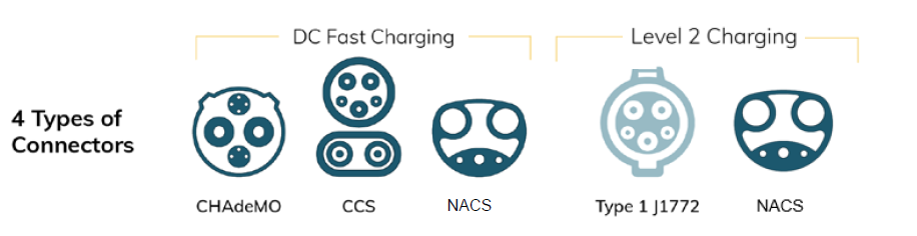
Connector Types
Did you know? Many automakers will start using the North American Charging Standard (NACS) connector in their EVs starting in 2025. Adapters are also available to use other connector types.
Find a Contractor
Install an EV charger at your home. PSEG Long Island does not endorse or recommend any EV Charger installer. The installers listed are participating contractors approved under the Electric Vehicle Training Infrastructure Program.
Find a Charging Station
Find nearby electric vehicle charging stations and see available chargers while you are on the go.
Frequently Asked Questions
-
Batteries charge fastest when they are nearly empty (low state-of-charge [SOC]). Other factors may include outside temperature, battery & vehicle age, as well as your vehicle’s power limits. Not all EVs charge at the same speed. Some EVs can only accept 50 kW DC Fast Charging, while some can accept as much as 250 kW. All EVs have what is called a charging curve, which allows EVs to charge fast when you have a low SOC, as you approach 80% SOC, the battery management system may slow down the charging speed to help preserve battery health and increase longevity.
-
When comparing Level 1, 2 or DC Fast Charging, its important to know that while battery electric vehicles (BEV) can use all charging levels, Plug-In Hybrids (PHEV) typically can only use Level 1 or Level 2 charging. Level 1 chargers allow to use an available household outlet but is slow. Level 2 will typically require some electrical work, but offers faster charging compared to Level 1. DC Fast Charging is great for those that need a quick charge while traveling.
-
PSEG Long Island’s EV Make Ready Program offers incentives for the infrastructure needed to power charging stations at multi-family, workplaces, and businesses. Note that the property owner should apply for the program. Learn more about the EV Make Ready Program.
-
An interactive map of Disadvantaged Communities can be found on NYSERDA's website. Learn more about our Household Assistance Program.
-
Level 2 chargers can range from 30 to 80 amps. Depending on many factors such as the size & age of the electric panel, available breaker slots, and more, a licensed electrician can determine if your electric panel needs to be upgraded.
-
This does not qualify for this program, unless if you can show that you separately purchased this charger, and it is on the eligible chargers list.

Contact Us
Have a question? Select an email below:
Residential: PSEGLongIslandEVli@psegliny.com
Commercial: PSEG-LI-EVMakeReady@psegliny.com
Fleet Owners: PSEG-LI-EVFleet@psegliny.com
